The HAR file that grew up.
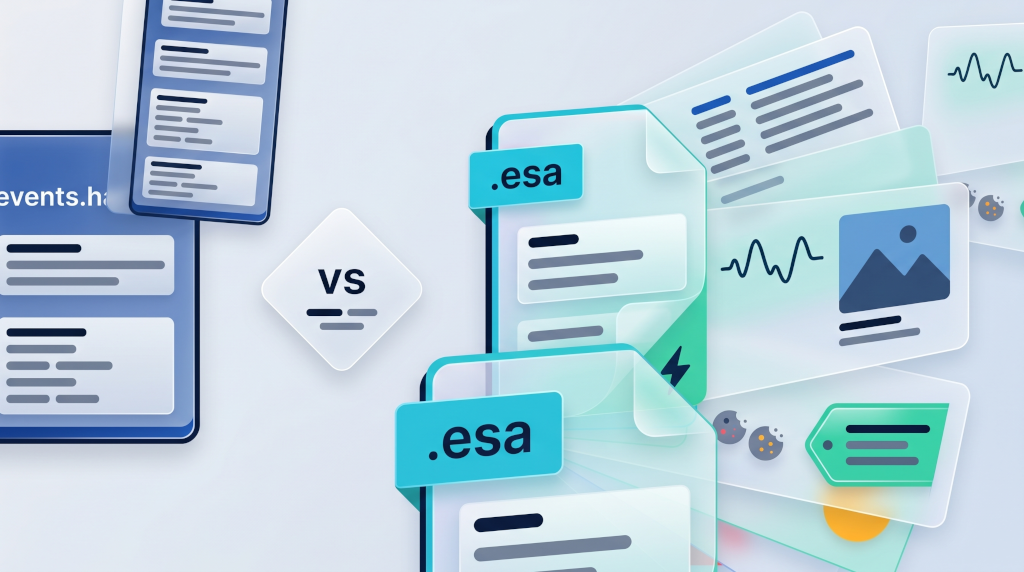
An Event Snapshot is a single .esa file bundling network requests, console output, WebSocket frames, SSE messages, an optional screenshot, the cookie jar and environmental metadata. It's HAR's job, done properly, and it works between any two webQsee users, free tier included.
HAR forgets too much.
HAR, the HTTP Archive format, was designed in 2007 for HTTP performance traces. It records request and response data, and that's mostly it. No console messages. No WebSocket frames. No SSE streams. No screenshots. No cookie state. No browser fingerprint. The things a modern debugger actually needs.
Event Snapshots fill the gap. One file, everything inside, ready to attach to a ticket or drag into someone else's webQsee window.
What's in an .esa
- Every captured HTTP request and response
- Every WebSocket frame (both directions)
- Every Server-Sent Event chunk
- Every console log line + stack trace
- A screenshot, visible area or full page, taken as you create it
- Cookies of every URL the page requested
- User agent, OS, browser, viewport, tab zoom, languages
- CPU, memory, connected displays, timezone offset
- Capture timestamp + event count
Event Snapshot vs HAR.
| Capability | HAR | Event Snapshot |
|---|---|---|
| Network requests | ||
| WebSocket frames | ||
| Server-Sent Events | ||
| Console messages | ||
| Screenshot | ||
| Cookies | ||
| User agent / OS / viewport | partial | |
| CPU, memory, displays, timezone | ||
| Selective subset export | (in webQsee) | whole capture |
| Readable by non-webQsee tools | ||
| File extension | .har | .esa |
Still need HAR for an external tool?
We export HAR too, with the same selective subset choice. Reach for .har only when the receiving tool isn't webQsee (Postman, Charles, perf analyzers). For human-to-human handoff between webQsee users, .esa is the format.
Free users get the full file.
Unlike Behavior Reports, which require a paid tier to import, Event Snapshots can be opened by anyone with webQsee installed. Free users can drop a teammate's .esa into the Import tab and inspect every captured event.
An Event Snapshot bundles the whole capture together with a screenshot taken at the moment you create it, so the two always describe the same instant. That makes it the cleanest way to file a bug report: no "what version of Chrome were you on?" follow-up, no "can you screenshot it?" round trip. Just the evidence. If you do need only a handful of rows, export those as HAR or Excel instead.
How import worksTypical workflow
- Reproduce the bug with webQsee capturing.
- Choose Save or Export > Create Event Snapshot.
- Pick visible area or full page for the screenshot.
- Attach the
.esato a ticket or chat, or share it as a link. - Recipient drags it into webQsee and inspects it.
Stop guessing. Start webQseeing.
Add webQsee to Chrome or Edge in one click. Most features are free, forever, no signup needed. Upgrade only if your team needs cloud sharing, S3 storage and Pro-grade tooling.
Works in Chrome 103+, Edge 103+ and most Chromium-based browsers. Install instructions.